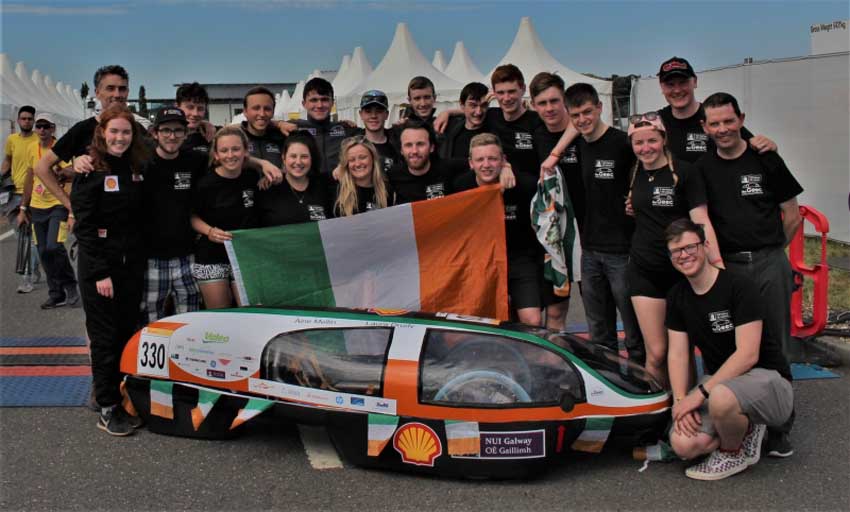
 The Geec is the first and only Irish team in the world’s top ultra-efficiency competition, and the most energy-efficient car ever built in Ireland.
The Galway energy-efficient car, the Geec, is an eco-car designed and built by NUI Galway engineering students. Every year since 2015, they have competed in Shell Eco-marathon Europe, a 16-km street-circuit race where the winner is the car that uses the least fuel or energy. This year they are the only Irish team and are down to the last three.
With an aim to decarbonise road freight transport, the Galway Energy-Efficient Car team identified the aerodynamics of heavy goods vehicles (HGVs) as a key area of potential improvement, following the discovery that a large proportion of engine power is required to overcome aerodynamic drag at high speeds.
Proposing an innovative aerodynamic HGV design, the team tackled a number of key areas of the traditional HGV that could be improved, including:
Truck face
Recognising that a flatter truck face increases the density of air and subsequently causes drag, the team proposed a curved surface that helps guide air around the truck more effectively.
Trailer gap
Another area that compromise the aerodynamics of an HGV is the gap between the truck and trailer, because it disrupts airflow and forms a vacuum. To overcome this, the team’s solution is a deflector that opens behind the cab automatically, reducing the gap when at high speed.
Wheels
Next, the team considered how to improve HGV wheels. Taking inspiration from the dimpled surface of a golf ball, they suggest wheel covers are attached to the rims, which reduce the wake to a greater degree than the smooth surface of traditional tyres.
Trailer tail
Lastly, the team targeted the trailer tail, recognising that adding a vortex generator could change the flow of the boundary layer by creating turbulence in a similar way to their wheel covers. Placing these at the rear of the truck helps to reduce the overall drag effect.
You can vote for the Geec to win the Decarbonising Road Freight Challenge here. You have until 23:59 GMT on Monday, November 23, 2020
Follow their progress
22 November, 2020