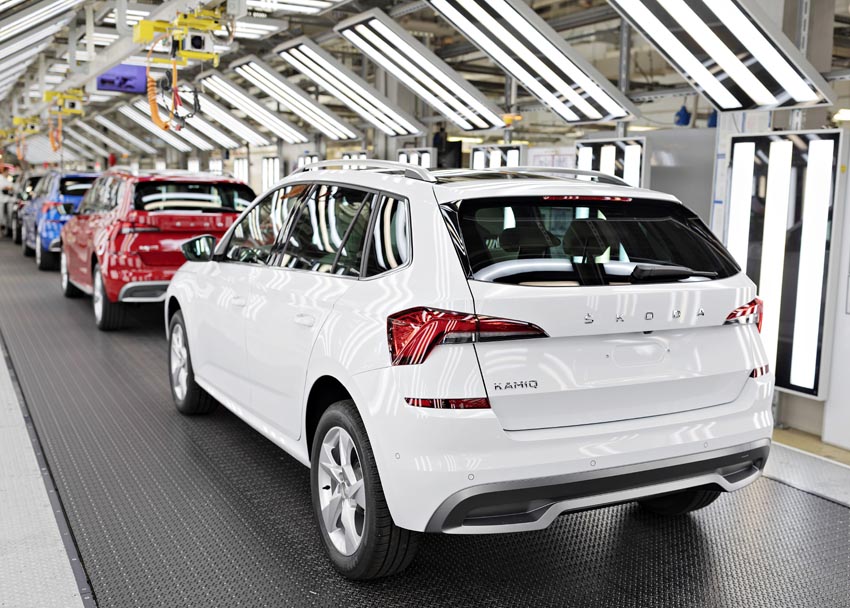
The two millionth SUV rolled off the production line at Skoda’s main plant in Mlada Boleslav.
Many issues are influencing the production and supply of cars, writes Geraldine Herbert
CHANGES TO VRT
Changes announced in Budget 2021 to the Vehicle Registration Tax (VRT) system, including the creation of nine new rate bands, came into effect on January 1. Designed to incentivise motorists to move away from higher polluting vehicles, CO2 bands now go from 7% to 37%.
Cleaner vehicles like plug-in hybrids and electric cars that emit up to 50g of per kilometre are charged at 7% VRT, while cars with a 191g per kilometre emissions rating or more are hit hardest with a 37% VRT rating. So far this year, diesel car sales are down 7.71%c on this time last year and petrol by 6.71%
IMPORTS ARE FALLING
Following months of negotiations, a Brexit deal was finally secured last Christmas Eve. The implications for importing a car differ depending on whether you are importing from Northern Ireland (NI) or Great Britain (GB). If importing from NI there are no additional charges as it is still part of the Customs Union. However, if you are an individual or a business importing from GB you are required to pay VAT at 23% (calculated on total price, including duty and shipping). In addition, there will be a customs duty of 10pc on some imported cars. This charge depends on what is known as ‘rules of origin’. These determine whether a product assembled in a country should be counted as a product from that country, or as an imported product. As of April, used imports are up 36.4% on 2020 but have fallen by 32.54% when compared to the same period in 2019.
ELECTRIC SALES ARE RISING
Despite a 16% drop worldwide in car sales in 2020, electric car sales were up 41%. Similarly in Ireland, as new car sales declined due to Covid, sales of electric cars increased by 16% and last year 4.54% of new cars sold were electric. So far this year 3,414 EVs have been bought, representing a 100.82% increase on the same time last year.
Battery electric cars now make up more than 6% of the total new car market and plug-in hybrid cars account for almost 6%. While the combined 12% is still below many European countries, it is significantly higher than the less than 1% market share at this time in 2018.
THE FUTURE OF HYDROGEN CARS
Volkswagen’s CEO Herbert Diess has cast doubt on the future of hydrogen cars in Europe. In a recent interview with the Financial Times he claimed that the technology would never deliver on the promise of an alternative clean energy source to battery power and there would be no hydrogen usage in cars for the foreseeable future.
Volkswagen – the largest carmaker in Europe – is not the only German carmaker sceptical about the advantage of hydrogen use in passenger cars. Both BMW and Mercedes-Benz have all but abandoned investment in hydrogen. Meanwhile, Toyota who launched the first mass-produced hydrogen car in 2014, plans to continue developing fuel cell technology and advocate that investing in multiple technologies will be a quicker and more inclusive way to achieve carbon neutrality around the world. At home, Hydrogen Mobility Ireland has developed a strategy for Ireland, setting out a pathway for the introduction of hydrogen production sites, stations and vehicles between now and 2030. Without support from key European carmakers, it would seem unlikely that progress will be made in the hydrogen passenger car market any time soon.
THE GLOBAL CHIP SHORTAGE IS IMPACTING CAR SUPPLY
The global shortage of semiconductors is causing supply issues for Irish car distributors. The shortage has been triggered by the pandemic. As lockdowns were introduced, demand for personal computers soared while car manufactures were forced to close their factories and cancel orders for chips. However, as the economy recovered, many chip makers diverted their production lines to the more lucrative consumer electronics market. A number of recent events are only adding to car makers problems, including the recently grounded container ship that blocked the Suez Canal, delaying chips headed from Asia to Europe; a drought in Taiwan, home to some of the world’s biggest and most advanced microchip manufacturers; severe weather in Texas that temporarily shut down chip production factories; and a fire at a Japanese plant owned by one of the world’s biggest makers of chips for the car industry. The situation is not likely to improve until well into 2022.
COVID-19
The pandemic and subsequent lockdowns have accelerated the move to selling cars online. During the most recent lockdown, dealerships were only open for essential services and repairs and yet from January to April 55,207 new cars were sold. The figure was 10% up on 2020 but down 24% when compared to the same period in 2019. Selling cars online is a trend that will remain, but whether it is likely to hasten the separation of sales and service in the future has yet to be seen. The pandemic has not only highlighted the need for a strong digital retail offering from car dealers, but also the need to embrace flexibility in a post-Covid market.
INSURANCE COSTS
Insurance premiums remain the number one financial concern for Irish motorists. The second motor insurance report of the National Claims Information Database published by the Central Bank states that in the past decade the cost of claims per policy fell by 9% due to fewer claims, while the average motor insurance premium increased by 35p%. In addition, the insurance industry generated profits of €142 million last year, with an operating profit margin of 10%. It is hoped that the impact of new guidelines introduced last month to cut awards given for most types of minor and medium-range injuries by 50% will begin to reduce the cost of premiums.
SUVS CONTINUE TO DOMINATE
According to Jato Dynamics data, SUVs continue to dominate the European car market and accounted for 40p% of all passenger car sales in 2020. This year, 43% of new cars sold in Ireland are SUVs – up 15% since 2018. Many environmental groups express concern about this trend, given that an SUV produces 18% more CO2 than traditional cars and even the smallest SUVs produce larger average emissions than executive cars.
PCP CAR FINANCE
PCP finance will continue to be a key driver of new car sales. However, such finance works best when used car values remain stable. Dealers and distributors will need to take a cautious approach to residual values for the diesel and petrol market as potential Government action regarding taxes in the future will continue to influence used car prices.
Geraldine Herbert
20th May 2021