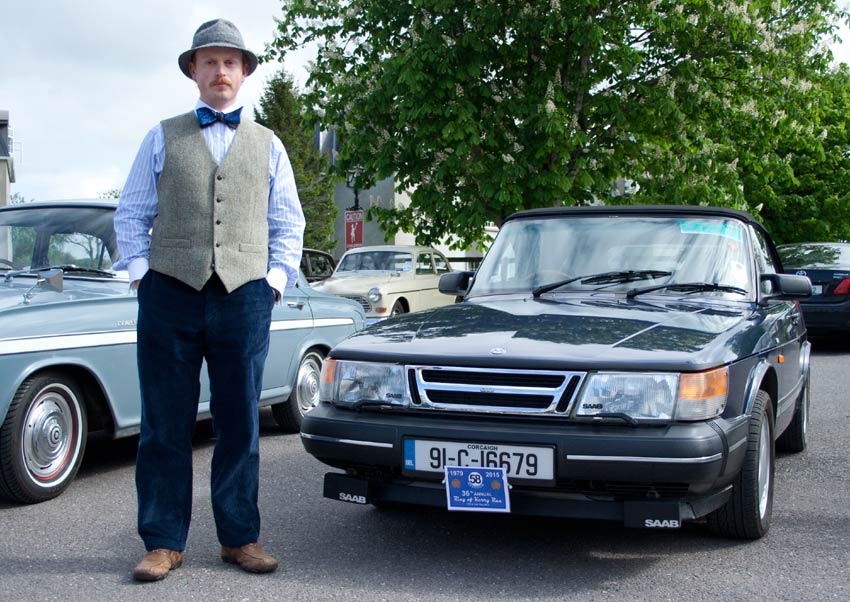
Alex Caridia with his Saab 900 Classic convertible.
Photo by Suzanne Keane
The Saab car brand may be no more but the enduring appeal remains writes Geraldine Herbert
When Saab filed for bankruptcy in 2011, Victor Muller, the Dutch entrepreneur who had rescued the company from General Motors’ attempt to close it two years previously described it as “the blackest day in my career and the blackest day in the history of Saab’.
Despite finding a buyer, it was GM that finally forced Muller to end his resuscitation bid. The US Car marker successfully blocked the sale arguing that a significant amount of GM technology was embedded in Saab vehicles and the sale to a Chinese company would compromise their intellectual property. With that the Saab name was put up for sale and ended a run of more than 60 years of car production.
Founded in 1937 by 14 aircraft engineers Svenska Aeroplan AB, were building planes long before they were building cars but were forced to diversify into car production at the end of the Second World War. They first produced the two-stroke-engine Saab 92 and over the next decade became a household name in Sweden. In the 1970s they launched their first turbocharged model – the Saab 99, the car that transformed the company and every Saab model that followed inherited its lineage.
Over the years the Swedish cars found favour with buyers for their unique blend of style, engineering and independent ethos.
Tim Kelly was an apprentice mechanic working at SAAB when he bought a four door 1983 900i.
“It had been unused for 2 years and was covered in muck, had flat paint, flat tyres and the headlining was adrift.” Recalls Tim
“Being an apprentice with no money and in need of a car, I fitted a new set of tyres, gave it a service, new brakes and a very good clean”
“ It was spectacularly reliable, nothing ever went wrong on it, the heated seats were a bonus in winter and it handled fantastically for a front wheel drive car due to the double wishbone front set up, and it steered beautifully”
He even managed to make money on it “I sold it for £800, so I made £400”.
Billed as the “thinking man’s car” Saab’s fighter jet heritage was for many, part of the attraction. Advertising campaigns were keen to emphasis the aeronautical credentials of the company.
With ads shot against the backdrop of runways the message was clear, you weren’t just buying a Saab you were buying a fighter plane with superior engineering and safety.
And it was a successful association, Ben Harrington, a motoring enthusiast and current owner of an eclectic vehicle mix including a 1974 VW Type 2, a 1998 Jeep Wrangler 4.0 and a 2006 Vespa PX125 scooter reckons the enduring appeal of Saab is that aircraft heritage.
“Saab has an air of masculinity possibly due to the jet fighter adverts I so enjoyed watching during my formative years” says Ben “it’s part of their reputation for reliability and Nordic ruggedness”.
27 year old Alex Caridia has an obsession for classic cars and is the proud owner of a 900 Classic convertible.
“I wanted one ever since I was 8 years old” says Alex “you only have to read their advertising slogan from the 1980’s “nothing on earth comes close” to understand why.
This UK advertising campaign was filmed by Tony Scott and it was rumoured that it was this that secured him the role of director for Top Gun. The 1986 film was one of the highest-grossing films of the eighties and made a star of Tom Cruise.
Saab’s quirky innovations and engineering had differentiated the brand from it’s more conservative German competitors and this distinction was valued by owners.
“It was a niche car and competed with Mercedes, Audi and BMW but was more unique” explains Karl Daly a financial advisor and previous owner of two Saabs.
“ The sleek Scandinavian lines said the owner was different and not part of the crowd”.
Saab won hearts with its aerodynamic style and quirky design, the centre ignition key designed to reduce knee injuries, the Night Panel button and odd styling. In 1992, they even made a car with no steering wheel. The idea behind it was to reduce driver injuries caused by hitting the steering wheel during a car accident. In place of a steering wheel was a joystick located in the centre console.
Unfortunately for Saab, their innovative approach didn’t attract enough devoted customers to make the brand profitable and in addition none of the models that followed the 99 Turbo appeared to have quite the same appeal. Saab was losing money on every car it made and General Motors took a 50 per cent stake in the company in 1990 and bought it outright in 2000.
To the dismay of many original Saab owners, under General Motors much that was being sold as a Saab was really re badged Opel engineering.
Paul Sherwood, a freelance photographer and ex Auto Express snapper has owned four Saabs – all convertibles including a 900 Aero Classic, a pre GM Saab.
“I bought the 900 Classic in Belfast, and had it until 2008” recalls Paul “ I loved the build quality, comfort, safety features and the engine”.
But as time passed General Motors couldn’t save the company and to many that was not any great surprise. Saab’s idiosyncratic and expensive approach to car building was never going to sit well with GM’s bottom line corporate management style. Under General Motors no separate path had been forged or funded for new Saab products to emerge.
In 2010 they sold the cash-strapped brand to Victor Muller’s Spyker Cars. In a rush to generate some much needed cash the new 95, a car that had been designed and conceived under GM management was put on sale. It did little to reverse the company fortunes and the new owners struggled financially. Despite Muller’s heroic efforts Saab’s days were numbered and they filed for bankruptcy in 2011.
Rich Bougaardt, a designer and artist owned four Saabs over twenty years and still mourns the passing the brand.
“It was an absolute disaster for anyone who appreciates good engineering and design done properly.” Says Rich and was a missed opportunity by GM. “doing a good job is more expensive than doing an average job in the context of building cars”
However all hope may not be lost; in June 2012 a newly formed holding company, National Electric Vehicle Sweden announced that it had purchased the bankrupted firm. Their plan is to relaunch the 93 for the Chinese market, while also developing a brand new all-electric car based on the platform.
So while there are many who are not holding their breath there are a few that still harbour real hopes that Saab can one day be revived.
Michael Creamer a devotee and past owner of three Saabs reckons there is still a huge amount of goodwill for the Swedish brand.
“The brand is still very much alive. I just hope one day we see new Saabs rolling out of Trollhattan and a revival of the brand as a strong going concern”.
Geraldine Herbert
27th June, 2016