The New Renault Clio
Gallic charm and low running costs have won the Renault Clio an army of fans since it was first introduced thirty years ago
The year is 1990 and if you were working at Renault you would have been glad to see it. Sure Renault was selling lots of cars and had done for years but the biggest of France’s big-three had endured a rough time of it. By the mid-seventies Renault resembled a Gallic British Leyland with too many people in too many factories building too many cars. The company would spend years under a cloud of state ownership. Renault had ambitious plans. They took a controlling stake in the American Motors Corporation in order to get a foot in the door of the lucrative US market. Attempts to flog locally built ‘Americanised’ versions of their European designs would end disastrously with Renault selling its stake in American Motors to Chrysler and retreating back to Europe hastily. Cost-cutting came swiftly and painfully; by 1985 Renault was on the mend but the price of saving Renault was huge. Thousands were left out of work and if all of that wasn’t enough an obscure left-wing guerrilla group looking for high profile targets shot Renault CEO Georges Besse dead in a Paris street in 1986. For Renault, now independent and profitable, 1990 was a good year.
Renault 5
A new decade would see a new chapter in Renault’s story. The Clio which would replace the iconic Renault 5. The R5 is credited with inventing the supermini class which still dominates the roads today. The 5 alongside Fiat’s 127 would write the rulebook for what a small car should be. The 5 had a transverse engine, front wheel drive and a hatchback tailgate. Today small cars still follow this layout loyally. But the 5 was hugely influential whereas the Clio had a far tougher brief; replace the iconic 5, compete with a throng of new pretenders and sell in the millions.
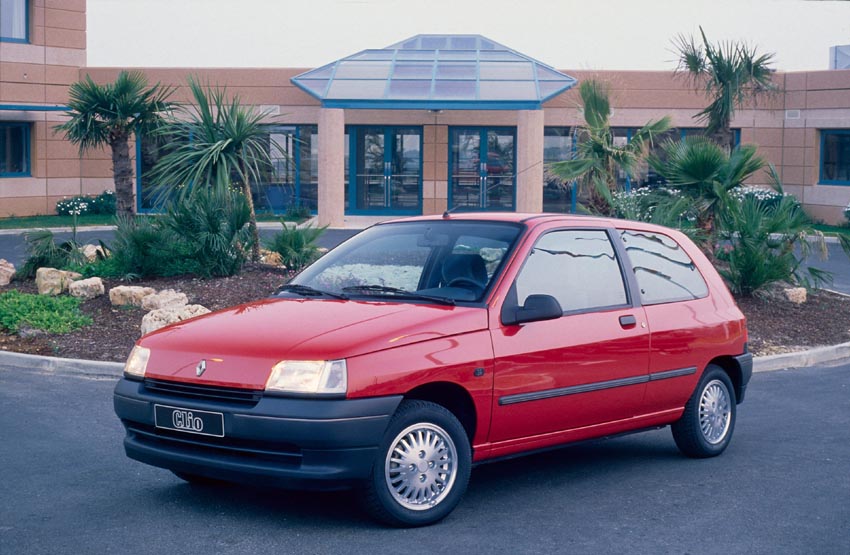
Renault were nervous about replacing an institution like the 5 with a new car so production of the old model transferred to Slovenia and continued as a budget alternative until 1996. The Clio was conservative underneath the skin. MacPherson struts up front with training arms and torsen bars around the back meant the Clio ticked all the boxes of a typical late eighties supermini. Tuning was comfort biased which was typical of Renaults of the era although a wider track and a bit more tuning by the chassis engineers meant the Clio never exhibited the nautical levels of body roll exhibited by the old 5. The 1.2 and 1.4 E-type energy engines were carried over while continental demand for diesels saw both 1.7 and 1.9 oil-burners tucked under the compact, forward tilting bonnet. Equipment levels were generous for the time, ride and refinement were regarded as excellent and the Clio, while no game-changer, was a definite step forward for the class.
European Car of the Year
Renault’s reward was strong first year sales and the European Car of the Year award in 1991. The Clio would soon cement a reputation as one of Europe’s most consistently strong selling cars and would seldom be out of the continents top ten for the next three decades. It had its faults; the Clio inherited the 5’s flaky carburettors and rubbery gearshift while the seats were too soft the driving position was regularly criticised but overall it was a welcome addition to the marketplace and it made Peugeot’s arch-rival 205 look dated and tinny by comparison.
Renault sold the Clio successfully around the world; in Japan the car was called the Lutecia as Honda owned the rights to the Clio name. It was also built in Turkey, Belgium, Colombia and Argentina as well as its native France. Indeed the Flins Renault plant still produces the Clio; the latest generation only starting to roll off the line last year.
Renault updated the Clio constantly; new seats within a year, fuel injection by the end of 1992 and so on. Indeed Renault would officially update the Clio twice between 1990 and 1998; the last cars wearing larger rounded headlights and less brittle trim. However, the real star came a year after launch with the Clio 16V. A 1.8-litre 135bhp engine combined with plastic wings, extensively uprated suspension, beefed up brakes and the usual visual updates produced a car that to this day is considered one of the finest hot-hatches ever made. This car would spawn the Clio Williams, an even more hard-core hot version that was so in demand Renault dropped any pretence of it being a limited edition. The Williams would go on to enjoy a successful rallying career and well used Clio Williams are still a regular sight in rallying on the continent.
By 1998 it was time for the Clio to bow out and a new car, the second generation Clio, to step in. Less likeable than its predecessor it nevertheless sold millions and added a new chapter to the Renault story.
April 6th 2020